
⸻ Published: 24/11/2026
More marketable carrots through smart cooling
When carrots are placed into storage, the foundation is laid for their quality at delivery. Damage, slow cooling and moisture loss can result in fewer marketable kilograms months later. As storage once again requires attention, it is worth taking a critical look at both the crop and the refrigeration system. The choice of refrigerant is also becoming increasingly important. Changing European regulations make it essential to plan ahead.
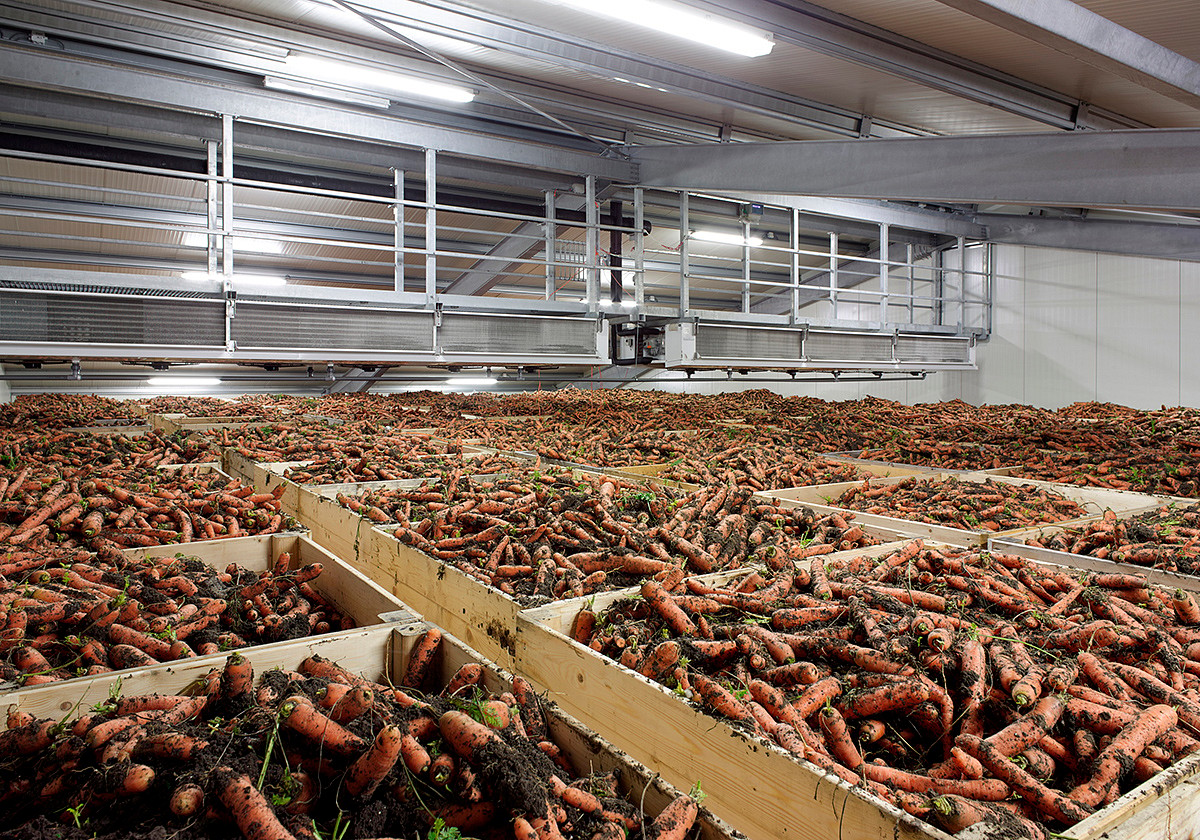
Before placing carrots into storage, assess whether the batch is suitable for the intended storage period. Check for rot and harvesting damage. Minimise drop heights and prevent breakage when filling the boxes. Cooling slows down quality deterioration but cannot restore the quality of an affected batch. Keep batches clearly separated and record field details, harvest dates and any specific observations. This allows for more targeted inspections and helps determine which batch should be delivered first.
Rapid and uniform cooling
Carrots continue to respire after harvesting, generating heat in the process. Therefore, start cooling to 6 °C as soon as possible. Then gradually reduce the temperature to the final storage temperature of around 0–1 °C, taking care to prevent freezing damage. A practical operating setpoint could be 0.5 °C, depending on the refrigeration system, measurement accuracy and temperature distribution. It is advisable to discuss this with your storage specialist.
Measure the storage temperature at several locations, including the centre of the boxes. A cold storage room does not automatically mean that all the carrots are cold. If a measuring point is cooling more slowly, check the air distribution before lowering the room temperature further. Follow the stacking plan and ensure sufficient air circulation. Avoid excessively cold air in localised areas and prevent freezing.
Cooling without unnecessary moisture loss
At a product temperature of around 0.5 °C, a relative humidity of 98 to 100% is the recommended starting point for long-term storage. This helps minimise weight loss and maintain firmness. At the same time, prevent condensation and dripping water, as these promote rot. Keep doors closed as much as possible and minimise temperature fluctuations. However, ensure that CO₂ levels do not exceed 5,000 ppm, as this increases respiration and the risk of quality issues.
Mechanical refrigeration removes field heat and respiration heat, even when the outside air is not sufficiently cold. The cooling capacity must match the daily intake volume, initial product temperature and desired cooling time. Calculating cooling requirements solely on the basis of the tonnage in an already cooled storage room is insufficient.
Moisture can condense or freeze on the cold surfaces of air coolers. This moisture is removed from the storage environment and may ultimately come from the carrots themselves. Sufficient cooling surface area and a small temperature difference between the storage room air and the cooling surface help minimise dehumidification. The refrigerant alone, therefore, does not determine how much moisture the carrots lose.
Increasingly stringent legislation
The European F-gas Regulation (EU) 2024/573 has been in force since 11 March 2024. It restricts the availability of HFCs and introduces stricter requirements for new equipment and maintenance. Global Warming Potential (GWP) indicates how much a refrigerant contributes to global warming compared to CO₂.
This means that the quantities of HFCs (such as R32, R410A and R134a) and blends containing HFCs that may be newly placed on the market will decrease significantly faster than under the previous regulation. For many other stationary refrigeration systems, including conventional direct refrigeration systems, a GWP limit of 150 will apply from 1 January 2030.
These restrictions on placing equipment on the market do not mean that existing installations must be replaced by that date. Separate restrictions apply to maintenance. Before investing in or expanding a refrigeration system, it is therefore advisable to assess the refrigerant, system type and future maintenance options.
Tolsma-Grisnich opts for propane
Tolsma-Grisnich has chosen the natural refrigerant propane (R290) for its GCU refrigeration units. This choice meets the demand for energy-efficient cooling and aligns with increasingly stringent European F-gas regulations. Propane has a very low climate impact in the event of leakage and is not subject to HFC quotas. This reduces dependence on refrigerants that are increasingly restricted by European legislation.
Tolsma-Grisnich uses propane in both direct and indirect refrigeration systems. In direct refrigeration systems, the refrigerant flows directly to the air coolers. In the indirect GCU-I system, propane cools a secondary coolant, such as a water-glycol mixture, which transfers the cooling capacity to the storage rooms. The propane remains within the refrigeration unit. This configuration offers the flexibility to cool multiple storage rooms at different temperatures.
For carrot storage, the key lies in the interaction between the refrigeration unit, air coolers and control system. Tolsma-Grisnich combines modern compressor technology with its Vision Control storage computer, which coordinates cooling and ventilation. Sufficient cooling surface area and a small temperature difference across the air cooler help minimise moisture loss.
In this way, the choice of propane is combined with the preservation of marketable kilograms of carrots. It is precisely this combination that determines the profitability of storage. After all, reducing losses by just one percentage point across 1,000 tonnes means an additional 10 tonnes of product can be sold.