
⸻ Published: 12/16/2025
Do you choose bulk storage or box storage?
Do you choose bulk storage or box storage?
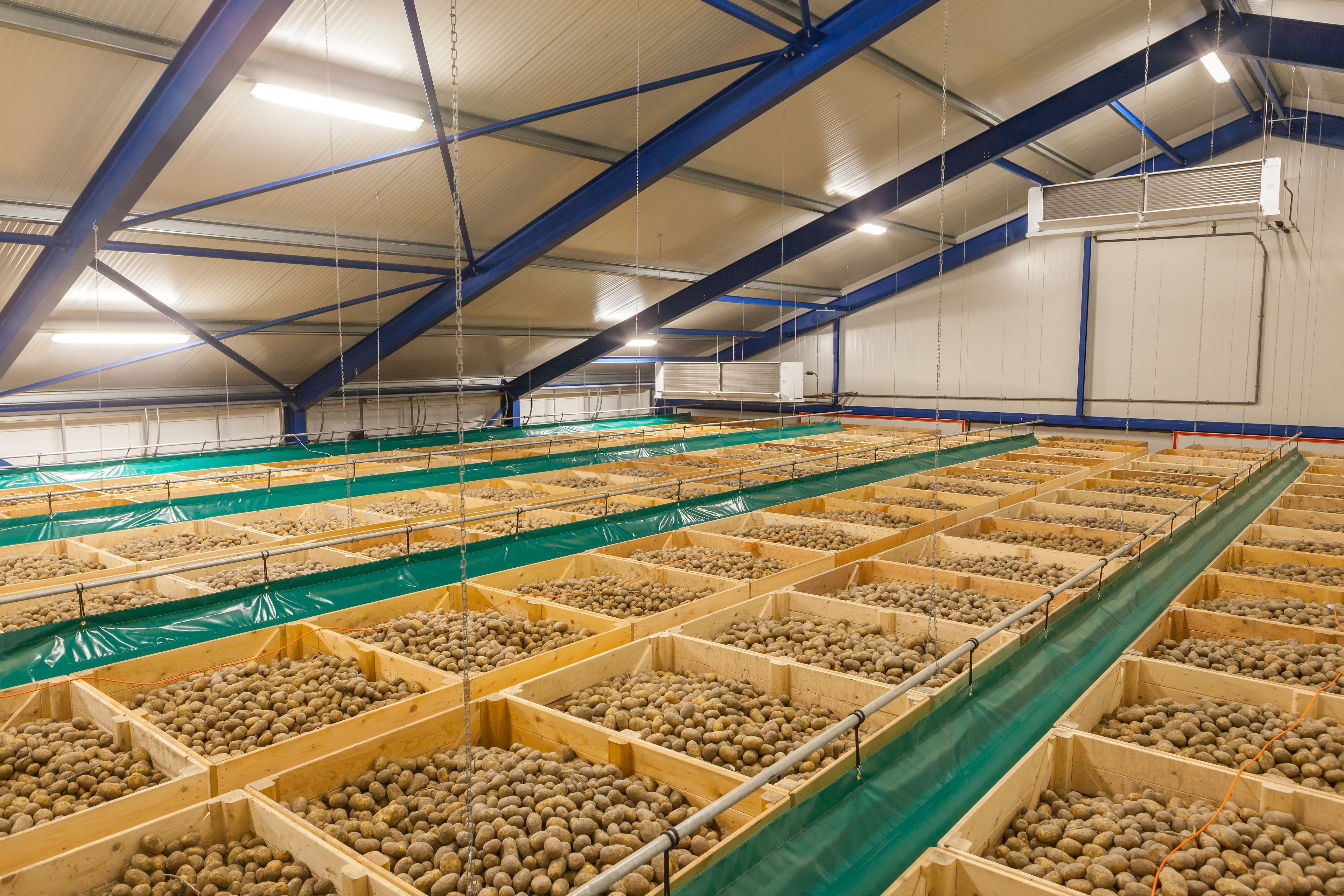
When constructing a new storage facility, one of the biggest challenges may well be choosing between bulk storage and box storage. Both systems have their advantages and disadvantages, with factors such as variety choice, region, and the grower’s personal preference playing an important role. With harvest approaching, in this edition of Actuele Akkervraag we take a closer look at storage facilities together with Jasper van de Braak of Tolsma-Grisnich.
Which option is most commonly chosen?
“That very much depends on the region you are located in. In the south of the Netherlands, such as Belgian and Dutch Limburg, we see that most arable farmers opt for bulk storage, mainly because French fry potatoes are predominantly grown there. However, in regions such as Flevoland and Gelderland, where a lot of seed potatoes are produced, most growers choose box storage. We do see a trend toward box storage becoming increasingly popular. It offers more flexibility in storage and marketing, is better for product quality, and allows for more precise control of the drying process.”
How does that control work?
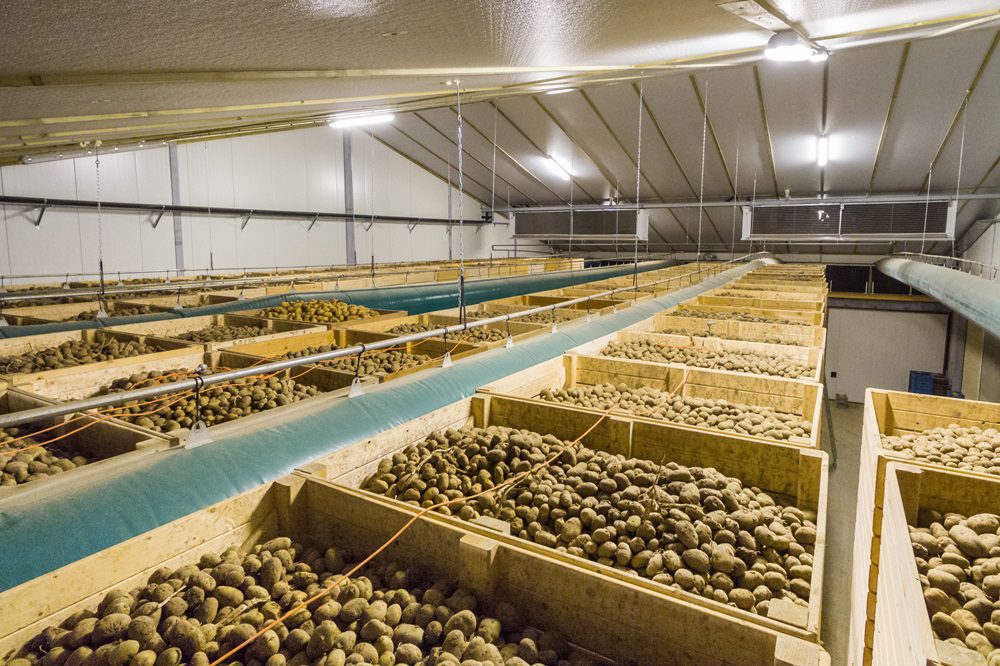
“The chosen storage technique largely determines how the storage process unfolds. Nowadays, systems can be designed to both blow and suck air. Blowing ensures that the rear boxes dry more intensively, while suction has the opposite effect. This allows you to steer the storage process depending on the needs of your product.
An advantage of blowing is that, because the upper boxes dry faster from bottom to top, monitoring is easier. With suction, this is somewhat more difficult.
For example, under wet harvesting conditions, you may end up with some wetter or lower-quality spots in a batch. These boxes can be removed if necessary, or you can run the fan slightly harder on specific rows, provided the storage is compartmentalized at the back of the pressure chamber. This works particularly well with an EC fan, as it allows both variable speed control and the option to switch between blowing and suction.”
Box storage versus bulk storage
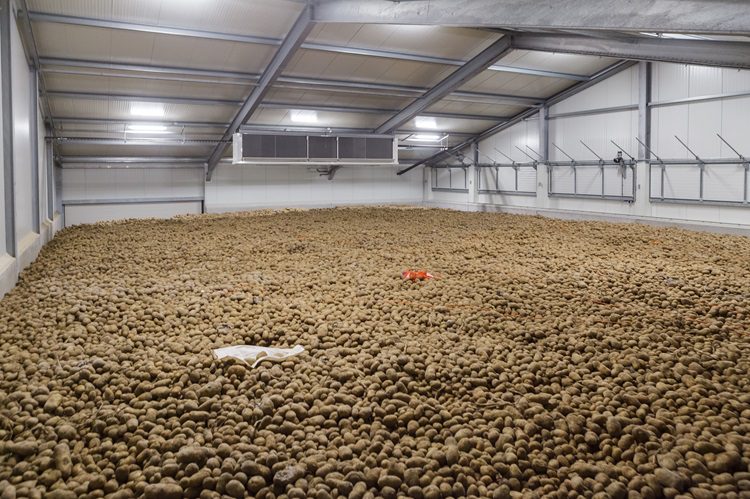
“With bulk storage, this level of control is far less straightforward. Box storage is also better suited for storing different varieties. You can keep varieties separated and market them individually. In addition, certain varieties, such as Agria, benefit from box storage, as this method leads to improved potato quality.
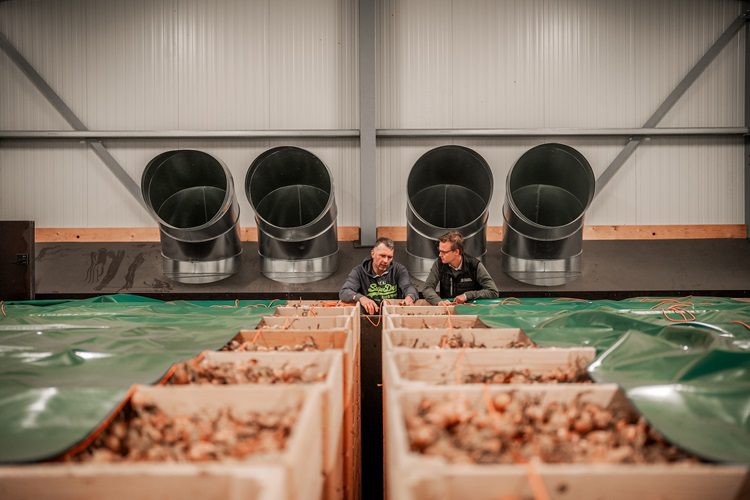
Box storage is also interesting for other crops. When onions are stored in boxes, there is less handling of the product, reducing the risk of skins loosening and thereby lowering tare.”
What does this mean for intake at harvest?
“There is a significant difference during intake. With bulk storage, you can haul large trailers straight from the field and store the crop quickly and efficiently. Box storage takes more time during intake, but again, it offers greater flexibility.
In practice, headlands and tramlines are usually harvested first, and these potatoes are often of lower quality. In bulk storage, these potatoes would end up at the back of the store. If rot develops, the entire cell would need to be emptied to access the affected area.
With box storage, we therefore advise placing these boxes temporarily under a roof. This allows some natural airflow and initial drying before the storage fans are activated. By placing these boxes at the front later on, they can be easily removed if problems arise.”
Which option is most financially attractive?
“Bulk storage requires pressure-resistant walls and a ventilated floor or possibly underground ducts. A storage facility designed for box storage is generally cheaper to build, but it does require additional equipment: a box filler, box tipper, one or two good forklifts, forklift operators, and of course the boxes themselves. All in all, the total investment for both systems ends up being roughly comparable.
However, box storage accommodates less product compared to bulk storage. Logistics also need to be carefully considered, such as forklift movements, as well as permits and local regulations regarding building height. Considering that boxes are approximately 1.25 meters high, a stack quickly reaches around 7.5 meters with box storage, compared to bulk storage, where potatoes are often heaped to around five meters.”
What is your advice for growers who are still undecided?
“Ultimately, I can provide plenty of explanation, but the best advice is to visit several newly built storage facilities together with a storage specialist. Preferably outside your own region, so you can compare options objectively. New construction offers many possibilities, which can sometimes be overwhelming.
Therefore, ask yourself the key question: if you were able to rebuild your current storage facility, what would you do differently? That will help you make a well-considered choice for the storage system that best suits your operation.”
Want to learn more about storage? Click here
Source: www.akkerbouwbedrijf.nl